White Deer, Knowing Owls: The Bestiary Waiting at Canada's Edge
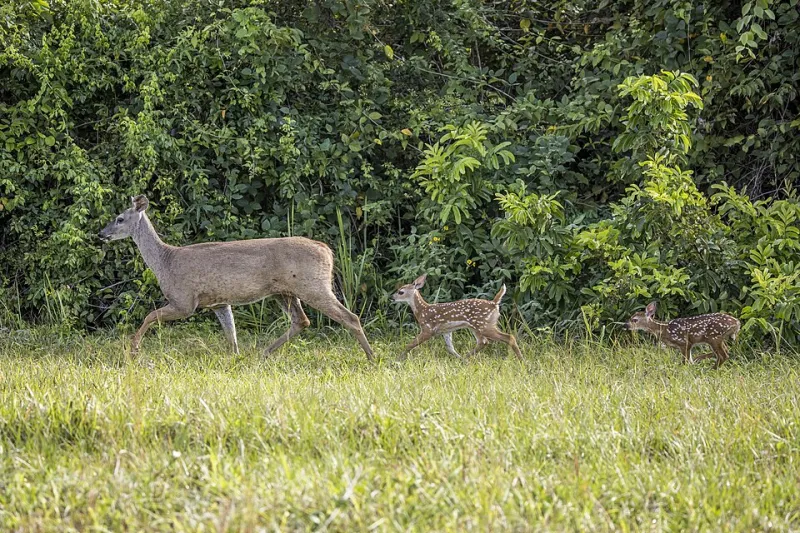
Photo: Charles J. Sharp, CC BY-SA 4.0, via Wikimedia Commons
There is a moment that recurs across decades of Canadian fantasy, and it almost never involves a wizard or a wardrobe. It involves an animal. A white deer steps out of the spruce and holds a child's gaze a beat too long. An owl swivels its head and appears, impossibly, to be listening to a name it should not know. A fox pauses on the snow at the exact edge of the backyard, close enough to the porch light that its eyes catch fire, and waits.
The reader who has grown up with the genre learns to read these moments the way a sailor reads weather. The animal is not decoration. It is a doorbell.
The Inheritance: Celtic Beasts on Boreal Ground
Canadian fantasy's animal messengers owe an obvious debt to the Celtic tradition from which so much of the genre descends. The white stag or white hind of Irish and Scottish story — the creature whose appearance dooms the hero to follow it into the otherworld — crossed the Atlantic with the settlers and their stories, and it found remarkably hospitable ground here. A country whose northern forests could plausibly produce an albino deer, a pale wolf, or a snow-white owl had no trouble absorbing the motif.
The result is a hybrid animal: part Celtic omen, part boreal fact. When Canadian writers send a white deer through a stand of birch, they are simultaneously invoking the Tuatha Dé Danann and the very real experience of encountering wildlife at the edge of a clearing — an experience so ordinary in this country that it can be rendered uncanny with a single change of colour or behaviour.
The genius of the device lies in that doubling. Canadian readers know deer. We have braked for them on the Trans-Canada, watched them strip the tulips in Oakville gardens, found their tracks criss-crossing the schoolyard in Sudbury. Because the animal is familiar, the writer needs only the smallest deviation — wrong colour, wrong hour, wrong stillness — to tip the whole scene into the otherworld.
The Owl That Knows Your Name
If the deer is the guide, the owl is the witness. Across Canadian children's and adult fantasy alike, owls function as the creature that has already crossed the boundary and come back. They are nocturnal, silent, and possessed of that unnerving frontal stare — the only bird whose face looks, uncomfortably, like ours.
It is no accident that the owl so often appears at thresholds: on the fence post at dusk, in the barn rafters, on the branch overhanging the ravine. In a genre built on the porousness of borders between worlds, the owl is the perfect sentry. It belongs to the night the way the otherworld belongs to the margins of the day. And because many species — the great grey, the snowy, the boreal — are genuinely northern birds, the fantasy owl requires almost no suspension of disbelief. It is simply our own wildlife, promoted.
The fox plays a subtler role still. Where the deer leads and the owl watches, the fox bargains. Trickster inheritance from both European folktale and, importantly, from the stories of the nations whose territories this country occupies, the fox in Canadian fantasy is the animal that appears to have its own agenda. It is not summoning the protagonist anywhere. It is simply present, and its presence implies that the two worlds have always been in conversation.
Why the Moose Never Makes the Cut
Which raises the question the genre quietly refuses to answer: where is the moose?
It is, after all, the most iconic animal in the Canadian imagination — enormous, ungainly, capable of appearing in suburban swimming pools and downtown intersections. If any creature announced the wildness pressing against our towns, it should be the moose. Yet it is almost entirely absent from the portal fantasy tradition.
The reasons are instructive. Portal animals must be liminal: beautiful, strange, or ambiguous enough to be read two ways. The moose is none of these things. It is unmistakably, aggressively real. A moose at the treeline is not an omen; it is a traffic hazard. Its sheer physical presence — a thousand kilograms of certainty — crowds out the ambiguity on which the genre depends. A child can follow a white deer into the forest. Nobody follows a bull moose anywhere.
There is also a question of scale. Fantasy thresholds are intimate: garden gates, ravine paths, frozen ponds. The animals that guard them must fit them. The moose belongs to the big wilderness, the rock-and-lake country that Canadian fantasy more often treats as a destination than a doorway.
Reading the Signals
For readers assembling their own maps of the genre, the pattern is worth tracking. When a Canadian fantasy opens with a familiar animal behaving slightly wrongly, the story has told you its central promise: the otherworld is not elsewhere. It is here, in the same woods where we walk the dog, guarded by creatures we half-recognize.
That may be the most Canadian gesture in the national literature — not the invention of impossible beasts, but the quiet insistence that the ones outside the kitchen window were never entirely ordinary to begin with.