The Boathouse Knows: How the Family Cottage Became Canadian Fantasy's Haunted House
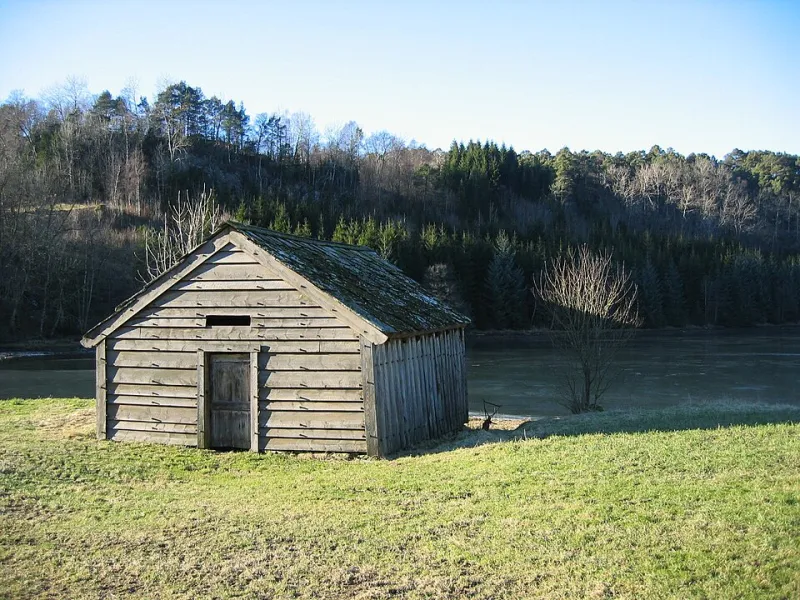
Photo: Jan's fotoside, CC BY-SA 3.0, via Wikimedia Commons
The haunted houses of English fiction sit behind iron gates on moors. The haunted houses of Canadian fiction float on stilts over dark water, smell of creosote and damp canvas, and have a guest book on the hall table.
The family cottage occupies a peculiar position in the national imagination. It is, simultaneously, the most beloved and least examined of our domestic spaces — a place where three generations of a family have slept in the same rooms, used the same chipped dishes, and told the same stories about the lake. Fantasy writers who understand what the cottage actually is have discovered one of the richest haunted settings available to them. Not because it is old in the European sense, but because it is old in the Canadian sense: layers of family memory compressed into a small wooden building that is closed up for eight months of the year.
A House That Hibernates
Consider what the cottage does. Every Thanksgiving weekend, it is shut — water turned off at the source, shutters latched, mattresses stood on end. It sits empty through the freeze and thaw, holding its breath. In May, a family returns and reopens it like a tomb, airing out the sleeping bags and finding what the winter left behind: mouse nests in the lifejackets, a wasp colony in the eaves, the previous summer's secrets still exactly where they were hidden.
This rhythm is the engine of Gothic fiction repurposed for the Canadian Shield. The Victorian haunted house is continuously inhabited; its dread accumulates in the present. The cottage's dread accumulates in absence. The child who finds something in the boathouse in June is finding something that waited, alone, through the whole of the dark. Any fantasy writer who has stood in a closed-up cottage on opening weekend knows the sensation — that the building has not been empty at all, merely patient.
The Guest Book as Grimoire
The props of cottage life are, almost without alteration, the props of folk horror. The guest book with its fading signatures is a register of everyone who has ever crossed the threshold — a document no fantasy novelist could invent that would be more believable. The trunk in the back room that belonged to a grandmother no one alive remembers meeting. The tin box of photographs of people standing stiffly on the dock in 1954. The axe in the woodshed. The canoe, that most liminal of Canadian vehicles, which travels equally well on water and, in fiction, on other waters entirely.
And then there is the lake itself, with its own inherited knowledge: the drowned island, the old campsite upstream, the story about what was seen from the point in some summer nobody will date precisely. Cottage lore is transmitted the way spells are transmitted — casually, half-jokingly, from an adult to a child at exactly the age when such things take root. A writer needs only to take this transmission seriously and the cottage story writes itself: the lore is true, and it has been waiting.
Inheritance and the Strange
What distinguishes the cottage from the standard haunted house is that its strangeness is familial. The ghosts of a Muskoka boathouse are not strangers; they are relatives. The heirloom locked in the drawer is not cursed by some ancient evil but by the ordinary weight of family history — an object that means something, and whose meaning has been deliberately obscured by the older generation.
This gives Canadian fantasy a register of the uncanny that is quieter and, arguably, more unsettling than the imported Gothic. The horror is not that something has invaded the family place. It is that the family place was always like this, and the children have only now been told — or worse, have only now noticed. The three-generation guest book becomes a record of a bargain made long ago. The musty boathouse becomes a threshold that someone in the family has been quietly maintaining.
Writing the Lake Country Chills
For writers looking to work this territory, the cottage offers practical advantages that a castle never could. Its isolation is plausible and unpaid for — no one wonders why the characters cannot simply leave. Its technology is charmingly fallible: the generator, the propane fridge, the one bar of signal at the top of the hill. Its seasons are structural. A story set over a single July has a natural clock ticking toward the closing-up, the shutting-out, the drive down the gravel road with everything the family owns in a trailer.
And its scale is human. The cottage is small. Everyone can hear everyone. Whatever waits outside is very close to wherever everyone is pretending to sleep.
The family cabin will never replace the moor or the mansion in the fantasy canon. It does not need to. It offers something those settings cannot: a haunted house that Canadians already belong to, already inherit, and already return to every spring — wondering, just a little, what kept without them over the winter.