Thresholds in the Backyard: Alison Baird and the Quiet Art of the Everyday Portal
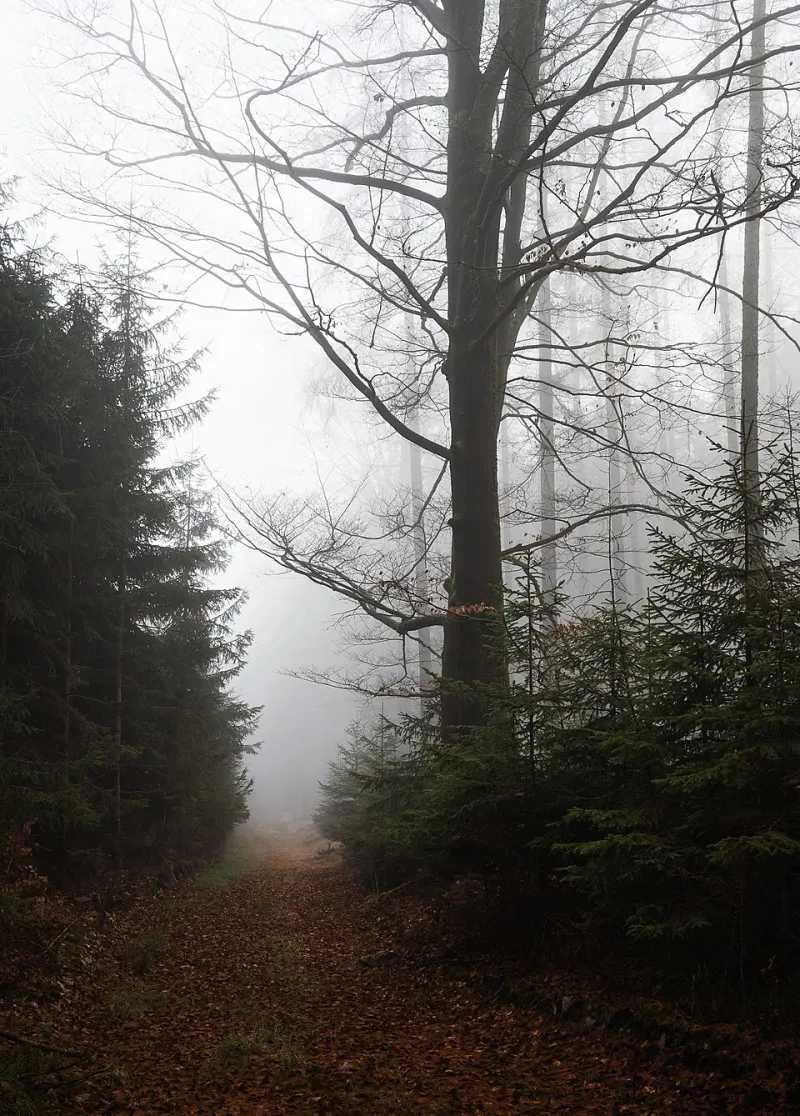
Photo: Ted Moravec, CC0, via Wikimedia Commons
Every fantasy reader knows the great portals of the genre: the wardrobe, the rabbit hole, the train platform hidden from Muggle eyes. They are theatrical thresholds, built for wonder at first sight. Alison Baird's crossings have never behaved that way. In her novels, the door to the otherworld is more likely to be a path behind a familiar fence line, a stretch of shoreline where the light falls strangely, or a quiet corner of a Toronto neighbourhood that residents walk past daily without a second glance.
The Portal Without a Fanfare
What distinguishes Baird's thresholds is how little ceremony accompanies them. Her characters do not tumble through vortexes; they step, almost absent-mindedly, into a world that was apparently there all along. The effect is less spectacle than recognition — the uncanny sense that the otherworld is not elsewhere at all, but adjacent.
This is a deliberate inversion of the portal tradition. Where classic British fantasy used gates to dramatise escape from a grey, wartime England, Baird's gates suggest no such rejection of the ordinary world. Her young protagonists cross over and come back, and the coming back matters as much as the going. The threshold is not an exit from Canada; it is a feature of Canada.
Domesticity as Worldview
There is something distinctly domestic about Baird's gateways, and it is worth taking seriously as a worldview rather than a stylistic quirk. A backyard that opens onto another realm implies that magic is a neighbour — something with a property line, something you can borrow sugar from, something whose presence changes how you treat the land you already occupy.
Readers raised on the Canadian landscape will recognise the logic. Our geography has always been a matter of near distances: the cottage lake an hour from the city, the boreal forest visible from the edge of a subdivision, the river that runs through town and into somewhere older. Baird's portals simply make literal what many Canadians already feel — that the wild and the other are never far off, and that the boundary between them is thin, permeable, and frequently crossed.
The Lakeshore and the City Street
It is tempting to locate Baird's thresholds only in wilderness settings, but that would misread her. Some of her most effective crossings happen in resolutely urban or suburban space — a laneway, a vacant lot, a stairwell in an older building. The pattern suggests a claim: the otherworld does not belong to the wilderness alone. It persists in the spaces we have paved.
This dual geography — the lakeshore and the city street — gives her work unusual range within the portal tradition. A reader in Kanata and a reader in Temagami can each find a threshold that resembles their own front door. That accessibility is not accidental. Baird's gates are democratic in a way the grand portals of high fantasy never were.
Influence on the Generation After
Any honest account of Baird's legacy must note how thoroughly later Canadian writers have absorbed her model. The low-drama threshold — the crossing that requires no spell, only attention — has become a recognisable mode in national fantasy. Authors writing now about apartment buildings with extra floors, or highways that exit into older countries, are working in a tradition Baird did much to establish: the portal as a fact of place rather than an event of plot.
The influence is also ethical. Because her thresholds are woven into ordinary landscapes, they carry an implicit instruction — that the world on this side of the gate deserves the same care as the world beyond it. Younger writers have taken that instruction seriously, producing fantasy in which respect for land and community is not a theme bolted on but a structural principle.
Why the Quiet Gate Endures
There is a case to be made that Baird's restraint has aged better than the pyrotechnics of her contemporaries. A portal that is a backyard does not date; a portal that is a special effect does. Her thresholds remain readable decades on because they are built from the durable materials of Canadian life — weather, water, distance, and the particular hush of a northern evening.
For readers encountering her work for the first time, the advice is simple: pay attention to the edges. The garden path that seems slightly too long. The lake that reflects a sky with no clouds in it. In Baird's fiction, as in the country she writes from, the gate is never locked. It is only ever waiting to be noticed.