Tea with the Otherworld: On the Small Encounters at the Heart of Canadian Fantasy
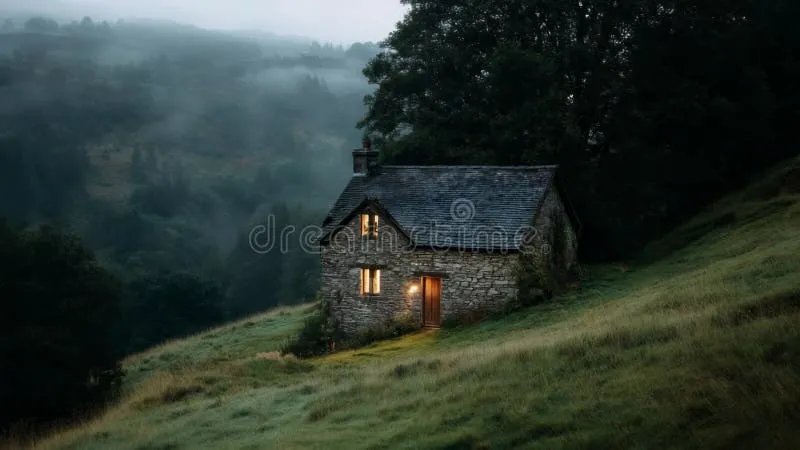
Photo: misty cottage garden gate at dusk with forest beyond, Canada, via thumbs.dreamstime.com
There is a moment familiar to nearly every reader of Canadian fantasy: a child, often alone and often unwilling, stands at the edge of something. Not an army. Not a dark lord massing beyond the mountains. A garden path. A lake at dusk. A door that was not there yesterday.
It is tempting to describe this as modesty, but that undersells it. The encounter with the strange — conducted quietly, at human scale, often in daylight — is the load-bearing structure of much of this country's fantasy fiction. Where the American epic tradition builds its cathedrals around war, the Canadian tradition tends to build them around a conversation.
The Meeting Rather Than the Battle
Consider how many of our most cherished scenes involve recognition rather than combat. A protagonist discovers that the heron watching her from the shallows is watching her, deliberately. A grandmother's story turns out to be a map. The otherworld, when it arrives, arrives the way weather arrives — gradually, and with a peculiar Canadian courtesy about announcing itself.
This is not to say nothing is at stake. The best of these encounters carry enormous weight precisely because they are small. When a creature at the edge of the garden speaks, the entire cosmology of the novel shifts on that single hinge. There is no cavalry coming, no prophecy to fulfil on schedule. There is only the reader and the character, both of whom must decide whether to believe.
Contrast this with the set-piece battles that anchor so much epic fantasy south of the border. Those books are magnificent, and their scale is part of the pleasure. But the Canadian instinct runs differently. We are, as a literary culture, suspicious of the grand gesture. Our history — of quiet compromise, of survival through endurance rather than conquest — seems to have taught our fantasists that the truest confrontations happen across a kitchen table.
Thresholds, Not Frontlines
The doorway is the signature image of this tradition. It recurs because it does double duty: it is at once an invitation and a boundary. Crossing it changes everything, and yet the crossing itself takes a second. The drama is not in the sword-stroke but in the hesitation before it.
One thinks of the young protagonists of classic British fantasy — Narnia's wardrobe is, after all, the ancestor of all these thresholds — but the Canadian versions have a distinct texture. Our doorways open onto recognizable places: a boreal shoreline, a Toronto ravine, a farmhouse pantry. The otherworld is not elsewhere; it is underneath. It is what the land already was, before we stopped paying attention.
That is perhaps the deepest difference. In epic fantasy, the enemy comes from outside and must be repelled. In the Canadian mode, the encounter is with something that was always here, and the real question is whether we are prepared to live differently once we have seen it. That is a harder moral test than any siege, and our novels know it.
What the Restraint Says About Us
It would be easy — and slightly smug — to claim this restraint as a national virtue. But the pattern is worth taking seriously on its own terms. A literature of small encounters is a literature that trusts its readers. It does not need the drums of war to justify its existence. It believes that a child meeting a dragon at the cottage door, and offering it tea instead of a spear, is a scene of genuine moral consequence.
There is also something distinctly northern about this patience. Our winters teach us that most things cannot be fought, only waited out. Our landscapes teach us that human beings are small, and that smallness can be a form of grace. The fantasy written in this climate inherits both lessons.
None of this means Canadian fantasy cannot do spectacle. It can, and occasionally does, splendidly. But when the spectacle arrives, it tends to arrive as a consequence of the small encounter — the garden conversation gone wrong, the threshold crossed carelessly — rather than as the point of the book. The battle is the echo. The doorway is the sound.
Why It Matters Now
In a moment when the fantasy genre worldwide is racing toward ever-larger scales — longer series, bigger wars, cosmic stakes — the Canadian preference for intimacy reads less like restraint and more like resistance. These books insist that wonder does not require an army, that the marvellous can fit inside a conversation, and that the most important thing a fantasy novel can do is change how you look at the ravine at the end of your street.
The dragon at the cottage door is not a reduced version of the dragon at the castle gate. It is a different question entirely. And it may be the question this country is best equipped to ask.