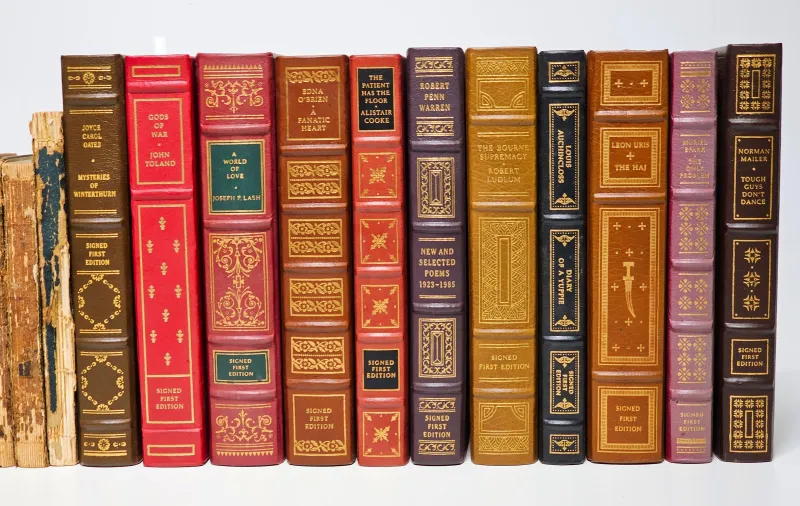
Lost in the Shelf? A Calm, Sensible Guide to Starting Any Fantasy Series
Photo: Internet Archive Book Images, No restrictions, via Wikimedia Commons
Every reader has stood in front of a bookshelf — at a library in Ottawa, a bookstore on Granville Island, a friend's guest room — and felt a familiar hesitation. Six volumes. A prequel. A companion book of tales. Where does one reasonably begin?
The good news is that fantasy readers have been negotiating this problem for decades, and a few steady principles will carry you through nearly any series.
Publication Order: The Traditionalist's Choice
The default recommendation, and usually the correct one, is to read in the order the books were published. Authors write sequels assuming their audience has read what came before, and the early books are generally written to welcome newcomers. Publication order also preserves the experience of discovery as the original audience lived it — mysteries unfold as intended, and reveals land with their full weight.
The main hazard of publication order is simple: if the series is unfinished, you will eventually run out of books. Every fantasy reader eventually faces this cliff, and every fantasy reader eventually forgives themselves for it.
Chronological Order: The Historian's Route
Some series span centuries, and publishers often renumber them chronologically once complete. Reading this way suits readers who prefer a tidy historical arc — the ancient past first, the recent events last. It is a legitimate approach, and for sprawling sagas with distant prequels, it can be deeply satisfying.
The trade-off: prequels frequently assume you know how everything ends. Reading them first can flatten the suspense the author carefully constructed. If a prequel was written twenty years after the original trilogy, it was almost certainly written for people who had read the trilogy.
What About the Companion Novellas?
Novellas and story collections are the wildcard. As a rule, they are seasoning rather than the meal: delightful if you love the world, unnecessary for the core plot. A sensible approach is to read the main sequence first, then return to the shorter works as a kind of second visit — like revisiting a favourite town in the Maritimes and finally touring the lighthouse.
A Practical Checklist
- Check the copyright pages. Original publication dates reveal the author's intended sequence, regardless of how a boxed set is numbered.
- Read the author's note. Many writers state plainly where they believe a newcomer should start.
- Beware mid-series renumbering. Trilogies that grow into longer series often confuse shelf order; trust the dates, not the spines.
- Give the first book a fair chance, but not an indefinite one. If a series is not for you by the end of volume one, the backlist will still be there.
There Is No Single Correct Door
Ultimately, reading order is a matter of temperament. The chronologist and the publication-order purist are both reading well. What matters is that you begin — ideally on a long winter evening, with a hot drink and no particular place to be. Fantasy rewards patience, and so does the reader who simply opens the first book and starts.